Featured

Close Up

By: Adam Bekhet

The film Close-Up is a tale of a man who finds himself deceiving an entire family for personal gain. And although it may seem the man behind all this must be sinister, but I actually found myself seeing the human in him by the time I finished watching the film.

Hossain Sabzian, Close-Up’s focal point is an average cinema lover. After riding a bus while reading a famous screenplay, a women approaches him and begins to appreciate the text. To impress this women he poses as the famous director and writer Mohsan Makhmalbaf. After fooling this woman she agrees to have her house and kids be in one of his upcoming films. As he visits her family multiple times the father of the family starts to become suspicious of Sabzain. At one point he even borrows money for cab fare. The father is convinced after seeing a magazine with a younger, different looking Makhmalbaf. After receiving further conformation that he is an imposer he calls the police on Sabzian who then gets arrested. Abbas Kiarostami, a famous screenplay writer, visits Sabzian and proceeds to try to speed his legal process up. In this segment of the movie, you can feel Kiarostami’s emotion parallel that of the traditional cold treatment they give Sabzian. During his trial, he is pardoned because he is a father with no record. At the end he meets the real Mohsan Makhmalbaf which ties the story together. Close-Up gives viewers an in depth view at Iranian Culture in the 80s.
Featured

The Crimes of Padre Amaro

By: Adam Bekhet

The Crimes of Padre Amaro, directed by Carlos Carrea shows the struggle between discipline and greed that priests face. It takes place in Mexico in the fictional town of Los Reyes.

Father Amaro is a newly ordained priest that has just recently arrived to Los Reyes. As we meet more of the main cast, it is clear to see the deep rooted corruption that lies not only in the church, but in the whole town.

The main priest in the area, Father Benito is building a hospital to serve the community. While the other priest in town, Father Natalio is facing backlash for his links to a left wing group. An affair by Father Benito in the past led to his mistress having a child named Amelia. At this point in time in the film Amelia was sixteen years old and working teaching religious text. She was mulling over marrying a young journalist named Ruben. Ruben and Amelia didn’t see eye to eye in the sense that Ruben was an atheist. It was well known that Ruben’s father was atheist and he was disliked for his strong opinions. Amelia was a devout Catholic which obviously created a disconnect between the two.

Amaro and Amelia quickly become charmed by one and other behind the back of Ruben. The newspaper that Ruben is employed by is given information that the hospital that is being built by Father Benito is actually a vessel for money laundering. Amaro and the church write a denial, which leads to Ruben getting fired. Following this, Amelia breaks up with Ruben harshly. Ruben has his house damaged by Catholics shortly after. After seeing Amaro in public, he assaults him leading to his arrest. Amaro does not press charges.

Featured

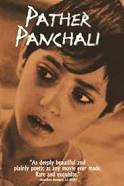
Pather Panchali

Pather Panchali is a film that represents a changing India in transition. The foundations of modern society and transportation are highlighted as being new and/or changing. This film captures India’s shift in society.

Apu is our protagonist in this story. His father and mother not always adequately able to feed him. He lives with his mother, sister, father, and his father’s cousin who is old and unable to take care of herself. The cousin receives mangos from Apu’s younger sister, which enrages their mother. She even kicks the cousin out of her house for encouraging her daughter to steal. The cousin returns to the home but the drama does not die. A neighbor accuses Apu’s little sister of stealing a necklace. Eventually, the cousin gets kicked out of the house for good due to the high maintenance involved with taking care of her. Apu and his sister later walk home from the train tracks, and see their father’s cousin dead in the forest due to their mothers negligence.

Their father eventually leaves home in search of a way to provide for his family. This leaves Apu with his sister and mother to make ends meet themselves. One day Apu’s sister is playing outside in a monsoon too long, which causes her to contract a severe case of pneumonia. The sickness quickly consumes her and she dies. His father returns only to find that his daughter has dies which leads him to collapse. Apu eventually decides that he needs to move his family near the river. As he is cleaning his house he finds the necklace that his sister denied taking. He throws this into the river.

Featured

Seven Samurai

By: Adam Bekhet

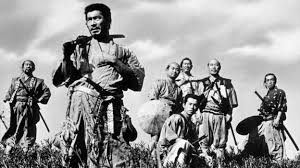
Seven Samurai is a well known film due to it’s famous plot line. It has been adapted to western film, most notably in The Magnificent Seven.

Directed by Akria Kurosawa, the epic storyline of recruiting protagonists was new to samurai films at the time. Kurosawa gained fame not only due to his excellent film-making and story telling ability, but also due to his ability to influence westerns through his work. His work is often referenced to this day regarding modern day film.

A small village was ransacked by bandits who come to take their crops. They decide to come back after the harvest. to protect themselves from danger and loss of food, the village elder decides to hire samurai to defend the city. After finding a samurai who is not motivated by money, but rather by doing the noble thing to do, they begin to assemble a team. After assembling a team they make their way back to the village. They don’t immediately see eye to eye. After finding common ground the villagers learn to trust the samurai. After much fighting and preparation they fend off the bandits, but not without loss. Villagers, including the town elder die. Four of the seven samurai die. Kambei, the most noble and first recruited samurai looks at the grave of the fallen samurai and says that the victory belongs to the farmers, but the victory does not belong to the samurai.

Featured

Bicycle Thieves

By: Adam Bekhet

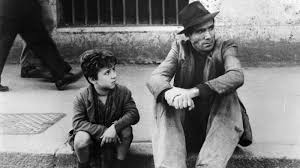
The film Bicycle Thieves is a classic representation of Italian Neorealism. The post-World War Two environment was one that was gloomy due to the fact that the country was still reeling from the effects of being on the losing side of the war. Italian Neorealism was a style that displayed the economic struggle, the social injustice, and the desperation of the Italian people.

Antonio is the main character of Bicycle Thieves. Like any other Italian man, he is looking for a job. An employment officer offers him a job posting posters around the city, the role even paid well. This was great news for Antonio until he realizes he needs a bike to accept the position. Lying through his teeth, Antonio says he has a bike as he is desperate for the position. His family sells their bed sheets in order to obtain Antonio’s bike. This initial display of poverty and sacrifice gives real insight to the state that Italy was in after the war.

After working and having a young man steal his bike, Antonio reports this crime to the police. They basically let him know that there is nothing they can do, leaving him distraught. After chasing leads around town all day, Antonio find his thief, chases him down, and pulls him into the street. After intensely trying to force an answer out of the young thief, the thief begins to have a seizure. After failing to retrieve his bike Antonio hits his lowest point. He sees an unattended bike and steals it. After being chased down by a mob the owner decides not to press charges. This film shows a struggle so hard that it could break a working man.

Featured

Metropolis

By: Adam Bekhet

Directed by Fritz Lang in 1927, Metropolis is a film set in the future that portrays a perfect city, or so we think.

This German Expressionist film is well known for it’s emphasis on emotion and silent nature. Metropolis was often thought of as one of the first science fiction films, especially with an extended run time. The film shows the economic disparity between those who work under Metropolis to keep it running, and those who own the city and enjoy the spoils at their expense.

After sailing into New York City with his wife on a vessel, director Fritz Lang saw the skyline which sparked his idea for the film Metropolis. Freder, the main protagonist in Metropolis is instantly mesmerized by a young woman named Maria. Freder finds Maria, but not after exploring the workers village and seeing the working conditions that the workers must endure. This sight disturbs Freder, who eventually finds Maria leading a peaceful uprising. She talks of needing someone who can connect the upper and lower classes to succeed. Freder then states that he could be that connection for the uprising.

Freder’s father, Joh can tell that Feder’s loyalty is in question as he sees his sons concerns for the lower class. After seeking the help of an inventor named Rotwang, Joh has planned to use his expertise to undermine the revolution. However, this plan becomes compromised as Rotwang is secretly helping the revolution instead. Rotwang’s role becomes vital in the meltdown of the city which sees the working class revolt and destroy most of the machinery.

The themes of the separation of classes and most importantly the heart, are the main sticking points of this film. Living in Germany between World War One and Two made expressing separation, pain, and economic disparity all too simple for German Expressionists.

Featured

The 400 Blows

By: Adam Bekhet

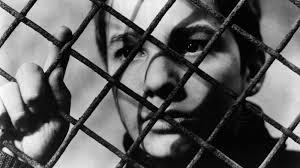
The 400 Blows, directed by Francois Truffaut is one film from the series The Adventures of Antoine Doniel. This film was meant at it’s time of release to move people with emotion. François Truffaut eventually won a Cannes Best Director Award in 1959 for his work in this film.

Antoine Doinel is a young adolescent growing up in Paris. His strict and parents and heavy-handed teacher push him to be consistently unhappy. This troubled start leads him to lie, steal, and run away from his own home.

As a new wave director, Francois Truffaut took pride in his filming locations. He used real scenes that often included backdrops of the unmistakable Paris skyline. His transitions and long shots showcased his ability to use minimal lighting and resources to create film that resonated with people. Truffaut’s ability to display detail in the day-to-day of life is what makes his work so powerful in my opinion. The last scene of the movie, where Antoine is shown running into the ocean is a big example of how Truffaut used limited resources to touch our hearts. Antoine runs to the ocean in a shot that makes the audience feel that he has finally broke free of oppression that holds him down. As the shot ends, Truffaut zooms in on Antoine until it is his face. This gives us time to understand the gravity of the situation, and time to feel his pain/freedom. Utilizing that shot just displays how a simple shot can have a strong effect and that exemplifies the French New Wave in my opinion.

The Milky Way

By: Adam Bekhet

The Milky Way is the first film of a trilogy directed by Luis Bunual. Following the Surrealist film style, The Milky Way this movie gave vivid detail to examine the Christian faith in a light I had not seen before.

The timeline of this film is vast. It spans over 2,000 years. The Milky way uses humor to jab at the Christian faith. This film follows two men on their journey from Paris to Spain using the route of The Way of St. James. This route is a traditional path for pilgrims to reach the Cathedral of Santiago de Compostela.

Upon first viewing i’m sure viewers in the late 60s/early 70s may have been upset with movie due to the fact that it wasn’t well received initially due to it’s religious slander. The Milky Way pays extreme attention to detail. Many of the events in the film that take place are actually based off of real historical documents. Jesus is even seen in this film interacting with a normal man. The structure of this film challenges what a lot of people thought was acceptable or morally correct. However the film did show fine details as far as religious details and was accurate in that sense.

Overall, I think The Milky Way was remarkable in the sense that it stayed true to its message. The level of detail is also astounding. This film may not always have drawn the most praise from religious crowds due to the nature of the film and the presentation of the Christian faith. However, it is still remarkable in its story and execution.

In The Mood For Love

By: Adam Bekhet

In The Mood For Love, directed by Wong Kar-Wai is a Korean film that tells a love story that goes against the grain when it comes to traditional love stories.

Made in 2000, In The Mood For Love was made in a favorable time period for South Korean cinema. Starting in the 1990s, Korean cinema saw more success despite the 1997 financial crisis. Steady box office earnings meant Korean cinema could flourish in the 1990s/2000s.

The film takes place in 1962 in Hong Kong. Chow mo-wan is a journalist that had started renting an apartment. He soon finds that a women named Su li-zhen has moved into the neighboring apartment. They quickly begin to find parallels within each others lives. They are both married to spouses that have high workloads. Their spouses work “overtime” often and rarely see each other. Chow and Su both understand that this means they are seeing other people, which draws the two of them together. Due to the bustling nature of their apartment building, they often times stay indoors in their perspective homes. Once again this similarity also brings them together. They begin to learn more about the affair that their spouses are having, and eventually find out that their spouses are cheating on them with each other. Chow eventually hires Su to help him with his job. Tenants eventually become suspicious of the two as they consistently spend more and more time with one and other. To combat this issue Chow gets a private hotel room where they can work in peace. Chow ultimately gets a job in Singapore, which requires him to move away. He asks Su to come with him, which was an offer she was hesitant to accept. Chow waits for Su in his lobby but eventually leaves. She comes down to leave with him, only to find out he has already left. This starts a series of badly timed meetings between the two which sees their romance die.

The Five Obstructions

By: Adam Bekhet

The Five Obstructions directed by Lars Von Trier is an experimental documentary made following the cinematic movement Dogme 95.

The film begins with Von Trier giving his mentor Leth, who is also another respected filmmaker a challenge. Von Trier wants Leth to remake The Perfect Human five times. The Perfect Human is Leth’s favorite movie. Leth also happens to be 19 years his senior. Every time that Leth shoots the film, there is a new obstruction. Hence the title of this film In his first task he must remake the film in Cuba, only using twelve shots. Although this seems impossible, Von Trier is very happy with the scenes when he comes back. His second task is to film the film in the worst place in the world without showing this place. His third task is a punishment for failing his last task. He is required to go back and film at his first location, or make it any way he chooses. Leth then finds help to make an animated version of his film, due to the fact that the fourth task was to make it as a cartoon. His last task is to narrate a version that Von Trier has already made, and take credit for it.

A film such as this one may not have the largest audience. However, the film was still received well. This film reminds me of nothing else. It has a unique way of grabbing the attention of the audience. I respect this film for it’s rawness and uncut nature.

Design a site like this with WordPress.com
Get started